
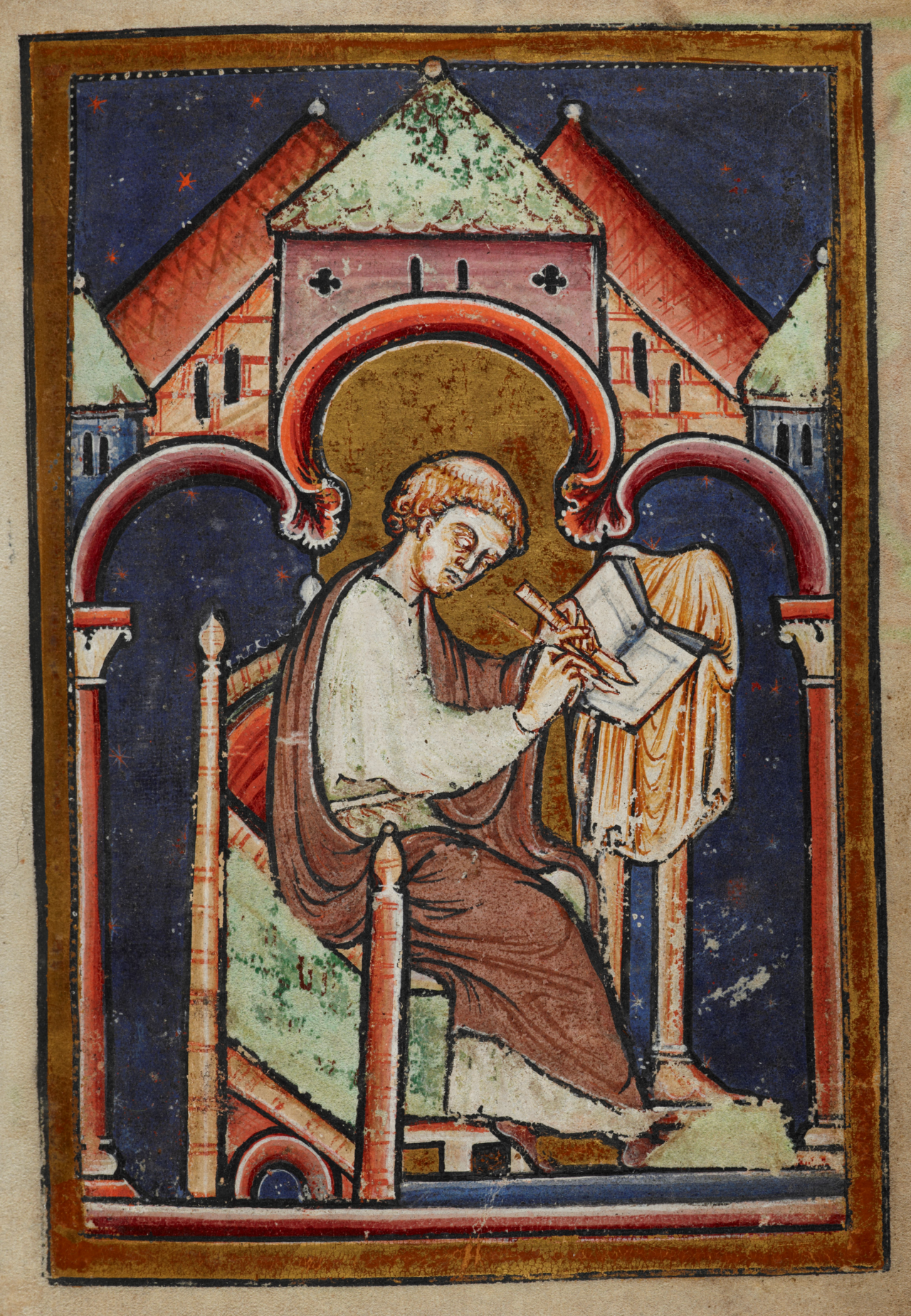
Bede was born around 672/673 AD (the exact timing isn’t known) in the kingdom of Northumbria, in what is now the northeastern England. Not much is known about his family, but at the age of seven he was sent to live at a monastery of Monkwearmouth-Jarrow Abbey. Abbot Benedict Biscop took the young Bede under his wing, and later Abbot Ceolfrith took over.
Bede received an exceptional education, he studied scripture, Latin, music, poetry, science and theology. At the time books were a rare thing, and literacy was limited. Monasteries preserved knowledge by copying manuscripts – they had a special room to do this called the scriptorium. A single book could take months or even years to complete. As materials were expensive and copying required great skill, books were precious and often they would be chained to the shelves to prevent theft!

Bede writing, from a 12th-century copy of his Life of St Cuthbert (Yates Thompson MS 26, f. 2r)
A lifetime of learning
Bede devoted his life to learning. He spent most his life in one place, which was unusual as many who would study history would travel around. Ordained as a deacon at nineteen and a priest at thirty, Bede became a respected scholar and teacher. He wrote a great deal on theology, biblical interpretations, chronology, poetry and science. His curiosity for the natural world led him to explore subjects such as astronomy and the calculation of time. Bede believed that learning was a form of worship. He saw knowledge and education as a better way to understand God and creation.
Bede’s most famous work is the Ecclesiastical history of the English people, completed in 731 AD. This book chronicled the history of Christianity in England from the Roman invasion to Bede’s own lifetime. It preserved stories, events and historical detail that might otherwise have been lost to time.

The Venerable Bede writing. Detail from a 12th-century codex.
Thanks to Bede, modern historians know about the important figures such as Saint Augustine of Canterbury, King Edwin of Northumbria and Saint Cuthbert.
Bede also played an important role in developing the dating system we still use today. He popularised the use of “Anno Domini” (AD) meaning “The year of the lord” helping establish the calendar tradition based on the birth of Christ.
After Bede’s death
Bede died in 735 AD at the monastery in Jarrow. He spend his final hours translating the Gospel of John into old English so more people could understand and read it.
Soon after his death, his reputation spread throughout Europe. Scholars admired both his intellect and his humility. In 1899, The Catholic Church officially declared him a Doctor of the Church. One of the highest honours given to Christian theologians.
Today Bede is remembered as the “Father of English history” his writings remain essential sources of understanding early medieval Britain.
Bede earned his name the Venerable as a mark of the deep respect for his holiness, wisdom and scholarship. The word venerable comes from the Latin venerabilis. Meaning “worthy of reverence” or “highly respected”
Today, the Catholic Church celebrates his feast day on 25th of May. He is also honoured in the Anglican communion.
Fun fact: our office cat is named after the Bede! He may not have achieved such amazing things as his namesake has, but he has an impressive “Merow!” and loves to sunbathe.

Leave a Reply
You must be logged in to post a comment.