
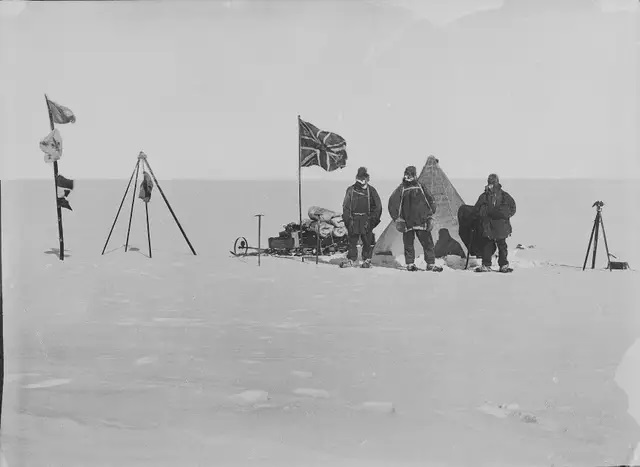
On 17 January 1912, Captain Robert Falcon Scott and four companions reached the South Pole. It was a moment that should have marked triumph at the end of months of brutal effort. Instead, it delivered disappointment. The Antarctic was never kind, and Scott’s journey south was a brutal adventure.
This was no luxury cruise. The expedition ship Terra Nova carried a staggering cargo into one of the harshest environments on Earth: 33 Siberian sled dogs, 19 Manchurian ponies, three experimental motor tractors, 300 tons of fuel, 162 mutton carcasses, a prefabricated hut, clothing, food, and scientific equipment. The cost alone was immense £40,000, the equivalent of over £3 million today all invested in the hope of reaching the bottom of the world and returning alive.
Among the dogs on board was a young Siberian husky named Osman, destined to become one of the most remarkable figures of the expedition.
Osman the Great
Osman earned his reputation long before his paws touched Antarctic ice. As the Terra Nova sailed south near Campbell Island, the ship entered the infamous latitudes known as the “Furious Fifties”, where towering seas and relentless winds punish even the strongest ships. A violent storm battered the vessel, flooding the deck and hurling cargo and men from side to side.
In the chaos, a wave struck with such force that Osman’s chain snapped, and the dog was washed overboard into the freezing Southern Ocean. In waters where survival was almost impossible, another wave hurled him back onto the deck moments later. A crewman caught him just in time. Shaken but alive, Osman had cheated death itself. After the incident, Scott referred to him admiringly as “Osman, our best sledge dog.”

The Long Road South
Scott’s Polar Party left Cape Evans in November 1911 without his team of sled dogs. After 77 long, punishing days, hauling sledges themselves across the Ross Ice Shelf, up the Beardmore Glacier, and onto the Antarctic Plateau, they finally reached the South Pole, only to discover that Roald Amundsen, the Norwegian explorer, had beaten them there by more than a month.
The men stayed for little more than a day, taking photographs, recording observations, and erecting their flag beside the Norwegian one. Then they turned north, facing an 800-mile return journey across the same unforgiving terrain.
Almost immediately, disaster followed them. Edgar Evans was injured early in the return, weakened by frostbite, exhaustion, and a head injury. He died near the base of the Beardmore Glacier in February 1912.

Osman and the Crevasse
While Scott and his party struggled south and back by man-hauling, Osman continued to prove his worth on sledging journeys elsewhere on the ice. On one such journey, the team crossed a crevasse hidden beneath a fragile bridge of snow. Osman, running as lead dog, crossed safely. But as the rest of the team followed, the surface collapsed.
Still in harness, the dogs, except for two that dropped onto a narrow ledge below were left hanging above the abyss, with Osman anchoring one side and two dogs and the sledge anchoring the other. The strain on Osman’s harness began to slowly choke him, forcing the men to cut him free immediately to save his life. Even then, it took nearly two hours of careful, dangerous work to rescue the remaining dogs and recover the sledge. Osman survived yet again.

The Final Losses
Back on the return from the Pole, the Polar Party continued to weaken. Lawrence Oates, crippled by severe frostbite and unable to keep pace, made his quiet, devastating decision during a blizzard. “I am just going outside and may be some time,” he said, walking into the storm so the others might have a chance. He never returned.
Scott, Edward Wilson, and Henry Bowers pressed on, but relentless storms, extreme cold, and dwindling supplies stopped them just 11 miles from a vital food depot. Unable to go further, they pitched their tent for the final time. All three men died in late March 1912, most likely from a combination of starvation, exposure, and exhaustion.
Their bodies, and Scott’s final letters and journals were found months later by a search party, preserving the record of their last days and sealing the expedition’s place in history as one of extraordinary courage and devastating loss.
Historians wonder and argue, if Scott had taken his team of sled dogs the outcome would have likely been very different, and some of his team might have survived the journey back.

A Different Kind of Survival
Osman, however, survived. He returned home when the Terra Nova sailed north in 1913 a living reminder of the animals who shared the dangers of Antarctica and endured them in ways humans could not.
In a story so often told through human suffering, Osman the Great stands out as something else entirely: a symbol of resilience, instinct, and survival in a land that showed no mercy to those who walked it whether on two legs or four.


Leave a Reply
You must be logged in to post a comment.