
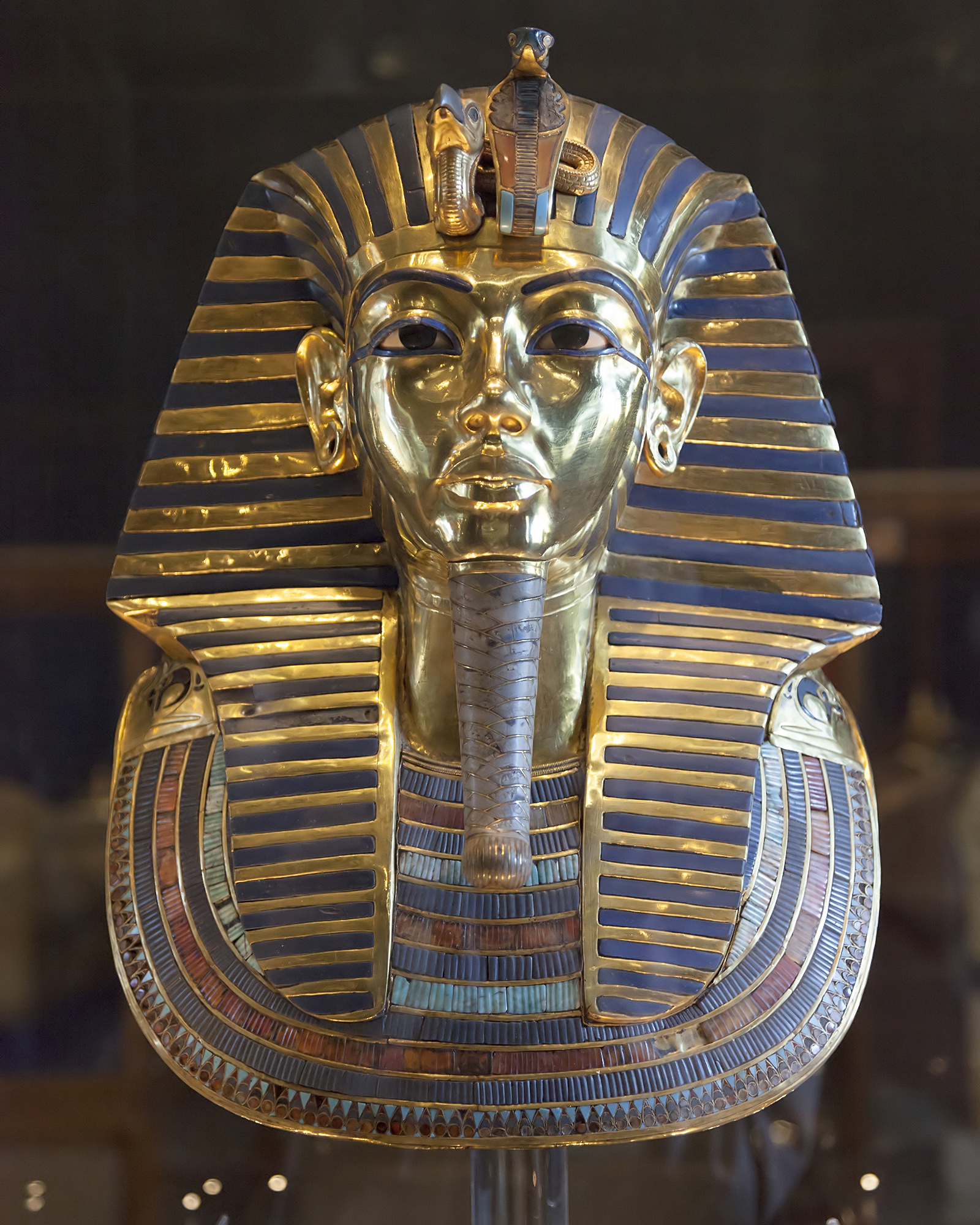
November is a significant month for those of us interested in Egyptology and the history of the excavations that have taken place in Egypt. It was on the 5th November 1922 that Howard Carter’s excavations first uncovered a sealed tomb entrance bearing the official seal of the Royal Necropolis. 21 days later, on the 26th November, modern eyes first alighted on the dramatic treasures that filled the tomb of Tutankhamun.
Who Was King Tutankhamun?
Tutankhamun was a young pharaoh of Ancient Egypt’s 18th Dynasty, ruling from around 1332–1323 BCE. He came to the throne as a child, probably around eight or nine years old, and ruled for only about nine years. Although he was not a powerful or long-reigning king, he became world-famous in modern times because of the discovery of his tomb.
Tutankhamun lived during a difficult period of Egyptian history. His father—presumed to be Akhenaten—had radically changed Egypt’s religion by focusing worship on a single god, the Aten. When Tutankhamun became pharaoh, advisers helped him restore the old gods, rebuild temples, and move the royal court back to Thebes. His name even changed from Tutankhaten (“living image of Aten”) to Tutankhamun (“living image of Amun”), reflecting this return to tradition.
Although much of his reign was guided by adults around him, Tutankhamun played an important part in stabilising Egypt after years of religious upheaval.

Howard Carter & the discovery of the Tomb
Howard Carter spent most of his working life in Egypt. Initially contracted as an artist and draughtsman on archaeological excavations, he trained under Flinders Petrie. Petrie and Carter were the first to take a real scientific approach to the archaeological excavations in Egypt. Later Carter was made Chief Inspector of Antiquities in Lower Egypt.
Carter had long wanted to excavate in the Valley of the Kings – his own study leading him to believe that there were things still to be discovered there. He was finally granted the concession to excavate in the valley after Theodore Davis gave up his right to excavate there in 1914 – but war prevented him from actively working on excavations until 1917.
Carter was lucky enough to have a wealthy patron for his excavations in Lord Carnarvon. Carnarvon and Carter’s excavations were mostly unexciting, but Carter worked carefully to record and preserve even mundane finds. Early on Carter located what appeared to be workmen’s huts from the building of the tomb of Ramses VI. It would eventually transpire that the entrance to the tomb of Tutankhamun was directly beneath these, but when he first uncovered them Carter chose to not excavate deeper at the time.
In 1922 Lord Carnarvon’s enthusiasm for Carter’s excavations was waning. Carter negotiated a final season of funding, with the proviso that if they found nothing remarkable he would reimburse Carnarvon for the year’s work himself. Under these terms Carter returned to Egypt in early November and began excavating beneath the workmen’s huts. In his lifetime he claimed he had not excavated here earlier for fear of blocking access to Ramses nearby tomb. It has been suggested recently that he might have suspected there was more to be found here and deliberately held off the excavations to reignite Carnarvon’s interest at an appropriate time, while allowing Carter to continue his thorough scientific work.

Whatever the reasons, the decision to excavate in this location led to an incredible find. On November 5th, 1922, Carter discovered a sealed entrance to a tomb and immediately sent a telegram to Carnarvon:
“At last have made wonderful discovery in Valley; a magnificent tomb with seals intact, re-covered same for your arrival, congratulations.”
The entrance – which turned out to be that of the tomb of Tutankhamun – had been robbed in antiquity but was later resealed. The passageway beyond was packed with rubble – disturbed at some point, yet carefully replaced.
When the rubble was cleared they came across another sealed door. A small opening in this was made and Carter himself was the first to look through. As his eyes adjusted to the candle light, he was reportedly speechless. Impatient, Carnarvon asked if he could see anything beyond the door. There have been many different reported answers to this question – both by Carter and Carnarvon as well as others. While Carter later wrote famously of “wonderful things,” in his journal he claims his reply was:
“Yes, it is wonderful.”

Six months after the discovery, Carnarvon died, giving rise to the longstanding rumours of the “pharaoh’s curse.” Carter himself worked for another 8 years to fully excavate and catalogue the artefacts found in Tutankahmun’s tomb.
The treasures are now housed in the Egyptian museum in Cairo.
Leave a Reply
You must be logged in to post a comment.